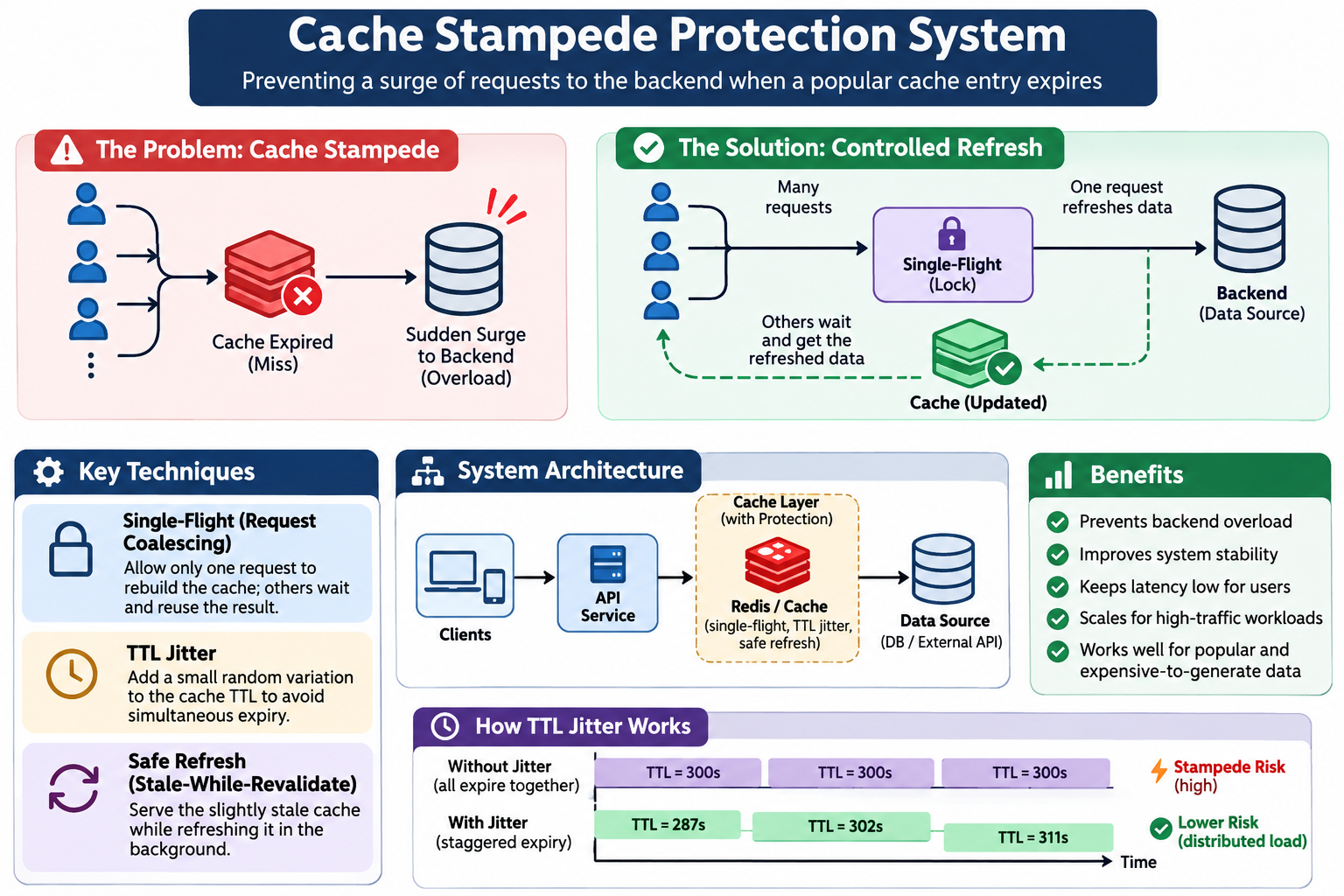
At noon, a popular product page loses its cached entry. The database query normally takes 100 milliseconds, but suddenly hundreds of identical queries arrive together. Adding more API replicas makes the problem worse: every replica independently tries to rebuild the same value. This is the cache stampede problem. In this design walkthrough, we build a cache that protects its origin even when the hottest key expires.
1. Define the problem and requirements
Functional requirements
- Return fresh cached values without contacting the database.
- Refresh expired keys without duplicating expensive work.
- Support cold misses, invalidation and bounded stale reads.
Non-functional requirements
- Bound database concurrency even during cache outages.
- Keep tail latency predictable; define explicit freshness limits.
- Recover from crashed refresh workers without indefinite locks.
2. Capacity estimation
Assume 10,000 requests per second for a hot key, a 100 ms database query and a 60-second fresh TTL. By Little’s law, approximately 1,000 requests arrive during a 100 ms refresh. Without coalescing, many of these may query the origin. This estimate assumes steady arrivals and no other bottleneck; actual load must be measured.
| Parameter | Illustrative value | Implication |
|---|---|---|
| Hot-key traffic | 10,000/s | High amplification risk |
| Origin latency | 100 ms | About 1,000 arrivals during refresh |
| Fresh TTL | 60 s | One coordinated refresh per window in healthy operation |
| Stale grace | 30 s | Optional availability buffer |
3. High-level architecture
Place stateless API replicas in front of a shared Redis cache and authoritative database. Each replica reads the cache, checks freshness and uses a per-key refresh lease when necessary. A bounded origin bulkhead prevents different hot keys from overwhelming the database together.
- Fresh hit: return immediately.
- Stale hit: return stale data only if policy allows, and attempt a background refresh.
- Cold miss: elect a refresh owner; other callers wait briefly with jitter or fail gracefully.
- Origin failure: retain allowed stale data; otherwise return a controlled error.
4. Low-level design
| Field | Purpose |
|---|---|
| payload | Serialized response |
| version | Authoritative revision used to reject older writes |
| fresh_until | Time after which refresh is needed |
| stale_until | Hard deadline for serving stale data |
| lock:key | Separate expiring lease with unique owner token |
Use Redis SET with NX and PX to acquire the lease atomically. Release it using an atomic compare-and-delete operation. A lease is not a guarantee of exclusive execution: a paused worker may resume after its lease expires. Where ordering matters, use an atomic version comparison or fencing token enforced by the destination.
5. Python example: local single-flight
The following runnable asynchronous example coalesces simultaneous loads within one Python process. It is intentionally not a distributed lock implementation. A production multi-replica deployment must also coordinate across replicas and enforce an origin concurrency budget.
import asyncio

class SingleFlight:
    def __init__(self):
        self.tasks = {}
        self.guard = asyncio.Lock()

    async def get(self, key, loader):
        async with self.guard:
            task = self.tasks.get(key)
            if task is None:
                task = asyncio.create_task(self._load(key, loader))
                self.tasks[key] = task
        return await asyncio.shield(task)

    async def _load(self, key, loader):
        try:
            return await asyncio.wait_for(loader(), timeout=2)
        finally:
            async with self.guard:
                self.tasks.pop(key, None)

async def main():
    sf = SingleFlight()
    calls = 0
    async def load():
        nonlocal calls
        calls += 1
        await asyncio.sleep(0.1)
        return {"price": 100}
    results = await asyncio.gather(
        *(sf.get("product:42", load) for _ in range(100))
    )
    assert calls == 1
    assert len(results) == 100

asyncio.run(main())
Shielding prevents cancellation of one waiting caller from cancelling the shared refresh. The loader timeout bounds the shared task. This example does not persist values or limit the number of distinct keys; add a cache and bounded admission control before using it in production.
6. Design patterns and alternatives
| Pattern | Strength | Limitation |
|---|---|---|
| Cache-aside | Simple ownership | Misses need coordination |
| Single-flight | Coalesces same-key work | Local scope unless distributed |
| Stale-while-revalidate | Low read latency | Not suitable for strict freshness |
| TTL jitter | Spreads expiry across keys | Does not solve one hot key |
| Bulkhead | Protects origin across keys | May reject excess requests |
7. API contract and failure recovery
GET /products/{id} returns a representation under the endpoint’s freshness policy. For public catalog descriptions, stale reads may be acceptable; checkout prices and authorization decisions may require authoritative validation. Never reuse one freshness policy for every data type.
- Redis outage: apply a bounded origin semaphore and reject excess requests rather than bypassing the cache without limits.
- Worker crash: allow the lease to expire; retry with jitter.
- Slow origin: enforce deadlines and avoid synchronized retries.
- Late refresh: reject older versions atomically.
- Invalidation race: coordinate writes and invalidations using authoritative versions.
8. Testing and observability
| Scenario | Expected outcome |
|---|---|
| 100 concurrent same-key requests | One local loader invocation in the example |
| Synchronized expiry across keys | Origin concurrency remains within budget |
| Worker dies during refresh | Lease expires and recovery is possible |
| Origin unavailable | Stale data served only within policy |
| Old worker resumes | Older version cannot overwrite newer value |
Track fresh and stale hit rates separately, origin requests per key, lock contention, refresh latency, rejected requests and p99 latency. Compare results against a baseline with coordination disabled. A high hit rate alone can hide dangerous bursts at expiry.
9. System design interview questions and answers
Why does a cache stampede occur?
Concurrent misses trigger duplicate origin work. The problem becomes severe for popular keys or synchronized expiration.
Does TTL jitter eliminate stampedes?
No. It reduces correlated expiration across keys but a single popular key can still stampede. Combine it with per-key coalescing.
Is a distributed lease enough?
No. Expiry and process pauses can produce overlapping refreshes. Use owner-safe release and enforce version ordering where needed.
How do you handle Redis failure?
Limit origin concurrency, use deadlines and shed excess traffic. Do not let every replica bypass the cache freely.
When is stale data unacceptable?
When business or security correctness requires current information, such as authorization or final checkout pricing. Validate against the authoritative source.
How would you validate the design?
Load-test hot-key expiry and failures, then compare origin amplification, p99 latency and errors against the baseline.
10. Conclusion and implementation roadmap
The core design decision is to protect the database from unbounded work, not merely to maximize cache hit rate. Start with local single-flight and a bounded origin pool. Add shared leases when replicas multiply, and use stale-while-revalidate only for endpoints with explicit freshness tolerance.
Before rollout, establish baseline metrics and test synchronized expiry, worker crashes and Redis outages. Introduce the design gradually on a hot read endpoint and compare origin load and tail latency. If freshness requirements are strict, prioritize correctness over stale availability. A cache that remains predictable under failure is more valuable than one that performs well only on the happy path.