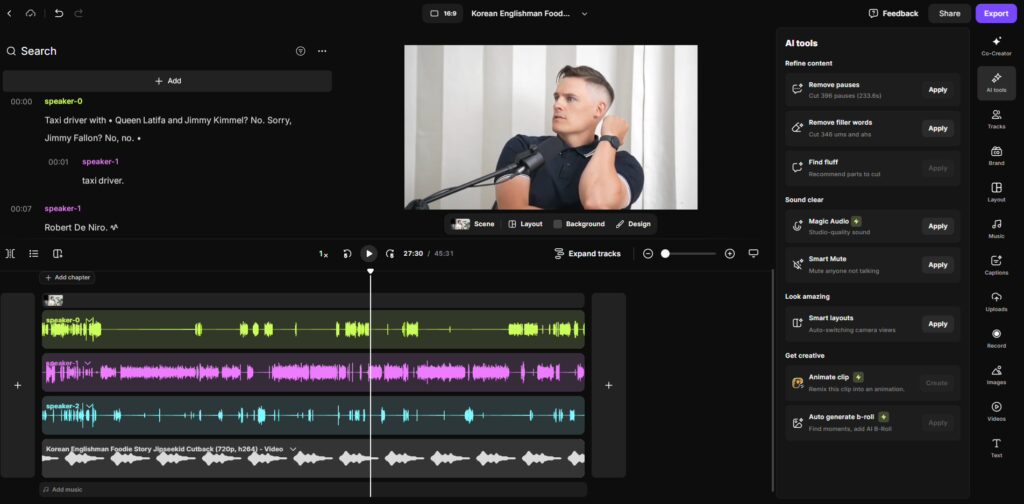
AI podcast editing tools are the ultimate “secret weapon” for modern creators who want to produce studio-quality content without spending forty hours a week in a dark editing suite. Have you ever sat down to edit a podcast episode, only to realize that a 30-minute interview is going to take you five hours to polish? Between cutting out every “um” and “uh,” balancing the volume levels, and trying to scrub out that persistent hum of your neighbor’s lawnmower, the “creative” part of podcasting can quickly feel like a chore. 😫🧤
But the landscape has shifted. We are no longer tied to manual, waveform-by-waveform editing. Artificial Intelligence has moved from being a futuristic concept to a practical, everyday co-producer. Today, the right AI podcast editing tools can “listen” to your audio, understand your speech, and even help you distribute your show to thousands of listeners with a single click.
Whether you are a solo creator or a professional production team, these tools are designed to give you back your time while making your show sound like it was recorded in a million-dollar studio. Let’s dive into the 5 best options for professional results! 🚀🎧
What are AI Podcast Editing Tools and How Do They Work? 🧐
An AI podcast editing tools suite isn’t just a fancy filter; it’s a collection of technologies like Natural Language Processing (NLP) and Machine Learning that treat your audio as data.
The Mechanism of Modern Audio AI
- Text-Based Editing: Some tools transcribe your audio into text, allowing you to edit the sound by simply deleting words in a document. Delete a sentence in the transcript, and the AI cuts the audio perfectly. 📝✂️
- Neural Noise Reduction: Instead of just “muffling” background noise, AI identifies what is a human voice and what is “noise” (like a fan or traffic), rebuilding the voice frequencies for crystal-clear clarity.
- Automated Distribution: AI analyzes your finished episode to generate show notes, social media captions, and even “audiograms”—short video clips that are optimized for platforms like Instagram and TikTok.
http://googleusercontent.com/image_collection/image_retrieval/9467549575233122718_0 (Alt Text: AI Podcast Editing Tools)
The Top 5 AI Podcast Editing Tools for Your Workflow 🏆
If you want to move from “hobbyist” to “professional,” these are the five tools you need in your arsenal.
1. Descript: The Industry Standard for Text-Based Editing ✍️🎥
Descript changed the game by making audio editing as easy as editing a Word document. It is widely considered one of the most versatile AI podcast editing tools on the market.
- The Killer Feature: Overdub. If you realize you misspoke or forgot to mention a sponsor, you can simply type the new words, and Descript’s AI will generate them in your own voice. 🤯
- Best for: Creators who want to edit audio and video simultaneously while generating instant transcripts.
- Check it out: Descript.com
2. Riverside.fm: The Remote Studio with AI Magic 🌐✨
Riverside is the go-to for remote interviews. It records high-quality local audio and video for every guest, so a bad internet connection won’t ruin your show.
- The Killer Feature: Magic Clips. With one click, Riverside’s AI identifies the most “viral” or engaging moments of your interview and turns them into vertical social media clips with captions. 📱🔥
- Best for: Interview-style podcasts that need high-end video and easy social media promotion.
- Link: Many pros use Riverside.fm because it saves hours of “syncing” audio tracks later.
3. Adobe Podcast: Studio Quality for the “Home Office” 🏠🎙️
Adobe has taken its decades of audio expertise and distilled it into an AI tool that is surprisingly simple yet incredibly powerful.
- The Killer Feature: Enhance Speech. You can upload a recording made on a cheap phone in a noisy room, and Adobe’s AI will make it sound like it was recorded on a professional microphone in a soundproof booth. 💎
- Internal Link: To pair your great audio with high-level leadership, see our guide on Soft Skills for Tech Professionals.
4. Castmagic: The Ultimate Post-Production Assistant 🤖📝
Once the recording is done, the work of “distribution” begins. Castmagic is an AI tool that takes your audio file and turns it into a full marketing suite.
- The Killer Feature: Content Repurposing. It automatically writes your show notes, timestamps, LinkedIn posts, and even newsletter drafts based on the actual content of your conversation.
- Best for: Business podcasters who need to squeeze every bit of value out of every episode.
5. Auphonic: The “Final Polish” Bot 🛁🧼
Think of Auphonic as the “automated sound engineer.” It’s a post-production web service that handles the technical stuff you probably hate.
- The Killer Feature: Loudness Normalization. It ensures your podcast hits the global standards (LUFS) perfectly every time.
- External Resource: Check Auphonic for automated mastering and leveling.
The Benefits and Challenges of AI Podcasting 🌈🚧
The Upside of AI Integration
- Speed: Tasks that took 6 hours now take 30 minutes. ⏱️
- Accessibility: You don’t need to be a sound engineer to have a professional-sounding show.
- Multi-Platform Reach: AI makes it effortless to turn one audio episode into five social media videos and a blog post using AI podcast editing tools.
The Hurdles to Watch For
- The “Uncanny Valley”: While voice cloning (like Overdub) is amazing, it can sometimes sound a bit robotic if overused. 🤖
- Context Mistakes: AI transcription is roughly 95-98% accurate, but it might still struggle with heavy accents or niche technical jargon. Always do a quick manual proofread!
- Loss of “Texture”: Sometimes, “perfectly clean” audio can feel a bit sterile. A little bit of “room sound” can actually make a podcast feel more human and intimate. ❤️💬
Future Trends: Where is Podcast AI Heading? 🔮
We are quickly moving toward “Real-Time Translation.” Imagine recording your podcast in English and having an AI co-host translate it into Spanish or Hindi in real-time, matching your original tone and emotion. 🌍🗣️
We are also seeing the rise of “AI Showrunners”—tools that will analyze your listener data to suggest what topics you should talk about next to maximize your growth. The line between “editing” and “strategy” is blurring, and AI podcast editing tools are at the heart of this transition.
Conclusion: Work Smarter, Not Harder 🏁🌟
The goal of a great podcast is to connect with your audience and tell a compelling story. Don’t let the “technical wall” of editing stand in the way of that. By leveraging AI podcast editing tools like Descript for editing, Riverside for recording, and Castmagic for distribution, you are freeing yourself up to focus on what matters: the conversation.
The most successful podcasters aren’t the ones with the most expensive equipment; they are the ones who are consistent. And in a world of AI, consistency is easier than ever.